“Centrifugus” was composed between 2020 and 2024. It premiered at the ICMC 2025 on June 11, 2025, in Boston. It was also accepted in the NYCEMF 2025 in New York and the SMC Conference 2025 in Graz.
Program Notes
Centrifugus is an acousmatic work for 8 channels. This piece explores the spatialization of sound objects through the application of centrifugal forces. How do we construct the geometrical center from the movement of sounding objects? A Neuter material that contrasts with noises and crackles is spatialized in each Section with different centrifugal trajectories. Each time those materials are reexposed, different centrifugal trajectories are applied. This work experiments with the relationship between the material and its perception when it is posed with different geometrical centers. The cognition of variation of the sounding materials is made using different centrifugal strategies. Such as changing the number of centers, the position of the centers, the type of centrifugal trajectories, the direction of the trajectories, and the velocity of the trajectories. A formal climax is created by the growing complexity of using these variations.
This work tries to achieve liquid tensioning through the conflict of the different centers. For example, Shuman created metric tension using conflict derived from the superposition of different metric layers
Eight sources are used to apply the spatial variations. Each one of these sources has been produced by a generative algorithm in MAX/MSP. The work begins with conventional trajectories and only one geometrical center. Slowly, the number of centers increases, and their positions move and change, creating different centrifugal trajectories around different centers located in different positions, and the centrifugal trajectories are more complex. Most of the used trajectories followed a spiral form. The conflict between the various centers creates a sort of spatial cognitive tension that can be interpreted as a spatial dissonance that arises from the different possible cognition of the center and the trajectories. The trajectories were made with the software Space Control. This spatial tension is relaxed at the end of the work by returning to the original simplicity.
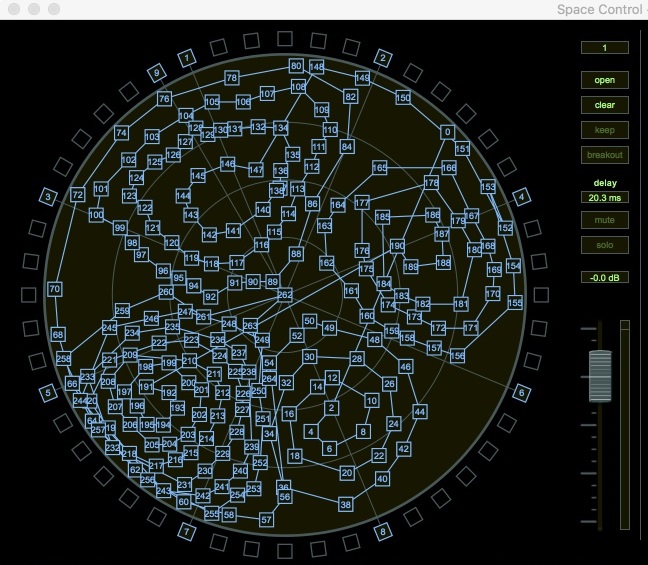
This work has been designed for an 8-channel space. The stereo version does not achieve the effect that the composer is seeking. Anyway, for accessibility purposes, it can be found at:
https://audiospace.soundingfuture.com/tracks/centrifugus
Acknowledgment
Thanks to Beñat Balza, Emiliano del Cerro, Jesús Marco Zamora, and Isabel Díaz de Avila for their collaboration in evaluating the work before the last release.
 Fernando Egido